


Arabesque mosaic – decorative tiles that define zones and guide the eye softly
Arabesque mosaic is a choice rooted in traditional Middle Eastern ornamentation, where it decorated interiors in a deliberate, consistent way. At Raw Decor, you get a timeless pattern that brings order to a surface.
Arabesque tiles can be a bold accent or a calm backdrop — depending on the color and composition — but they always keep an elegant, timeless tone. If you’re looking for a finish with presence, arabesque tiles bring it in without being loud.
What is arabesque mosaic and how is it different from classic tiles?
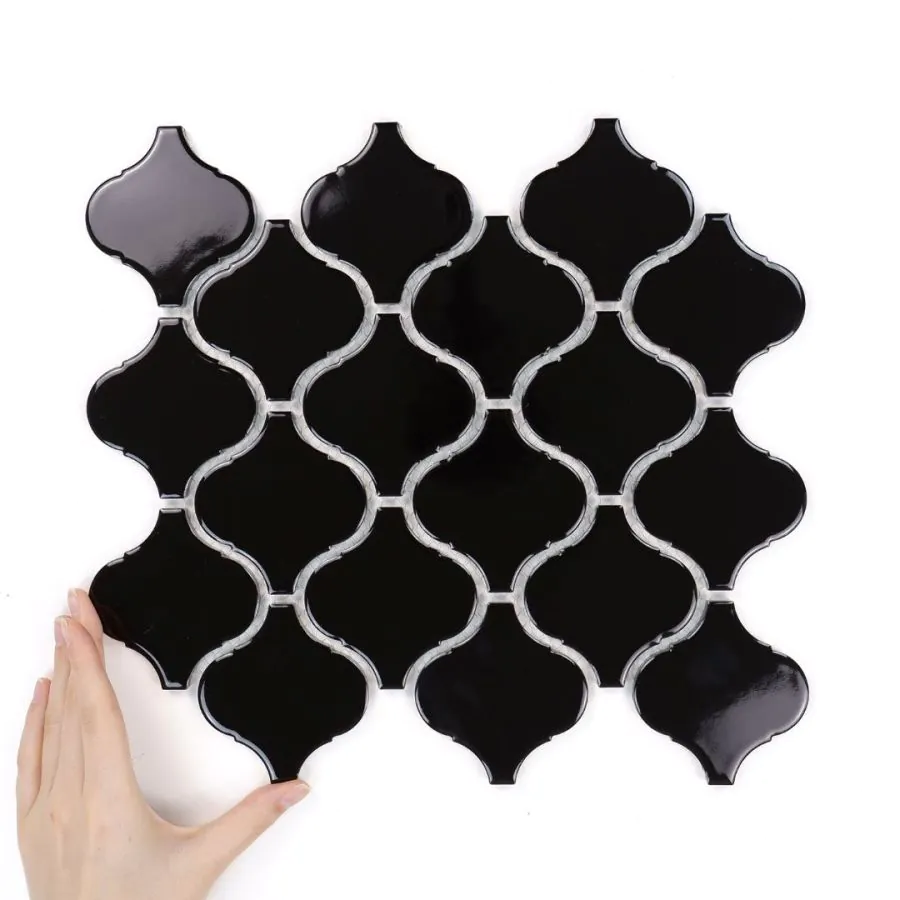
Arabesque mosaic is ceramic decorative tiles shaped like a Moroccan trefoil. They are mounted on a mesh backing, so once installed they create a continuous, repeating motif. In practice, it’s not a single tile that creates the effect — it’s the entire layout.
What sets arabesque tiles apart from classic solutions is how they work with a surface. Instead of straight lines and large fields, you get a modular pattern that organizes the wall on its own. Ceramic arabesque mosaic gives you more control over detail — it’s easier to fit into irregular spaces and smaller zones, without cutting large elements.
Arabesque mosaic today. What are the popular arabesque tile patterns?
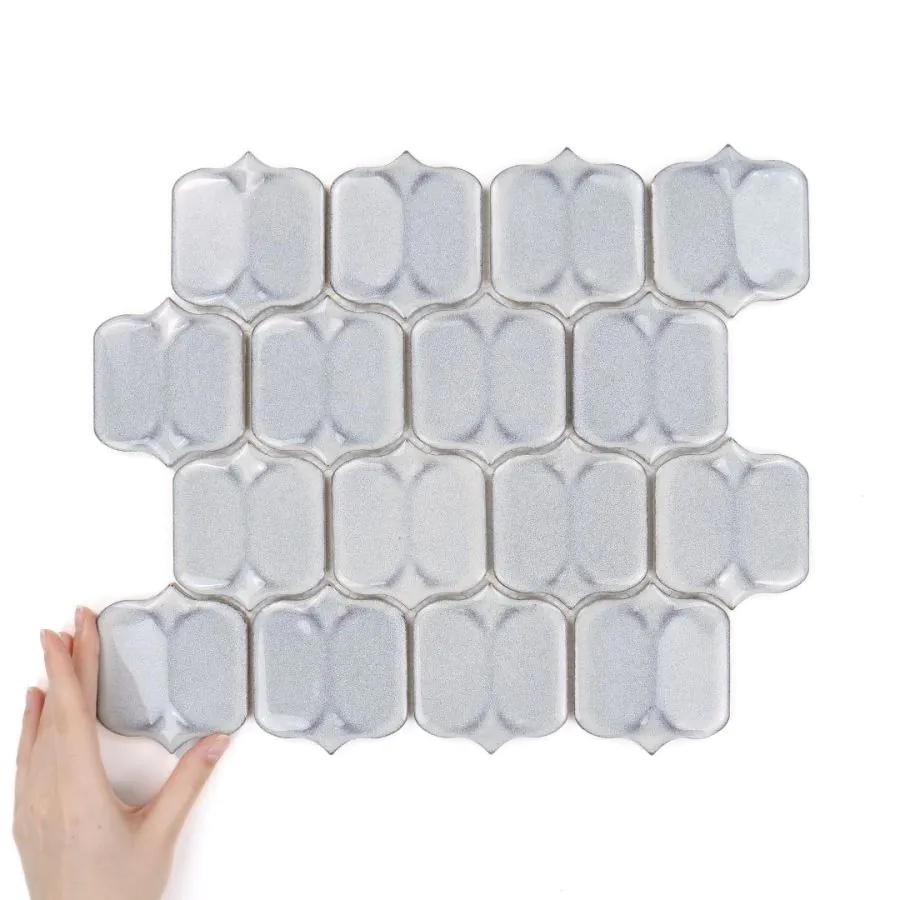
Today’s arabesque patterns are far more varied than their historical counterparts. Alongside the classic, soft arabesque, you’ll find contemporary interpretations of the shape — more elongated, simplified, or with a sharper outline. Thanks to this, arabesque mosaic can look both decorative — like Arabeska Mirage White Gloss — and very minimal — like Arabeska Small White Matte.
See how arabesque patterns can work on a wall — subtle, but intentional.
Arabesque mosaic colors — a calm background or a strong accent?
If you’re planning a renovation in 2026, treat the color of your arabesque mosaic as the first selection filter — it will decide whether it becomes a calm backdrop or a strong accent. Trends are on your side: earth tones lead the way — easy to pair with wood, stone, and warm lighting.
1. Arabeska Medium Cream Gloss — how does gloss change the way the pattern reads?
Gloss intensifies the arabesque outline — the flowing line doesn’t disappear on the wall; it becomes more defined. With Arabeska Medium Cream Gloss, the effect feels lively — in daylight the surface looks brighter and more decorative, while in the evening it shifts into a calmer, more uniform tone. In everyday use, keep in mind that gloss highlights droplets and marks, but it also brightens and visually enlarges even a small kitchen or bathroom.
2. Arabeska Medium Adriatic Gloss — how does a bold color transform the space?
Arabeska Medium Adriatic Gloss is a deep sea blue that shifts with the light — from turquoise reflections to a cooler navy. The gloss strengthens color on raised edges and deepens it in recesses, so the surface looks dynamic and “alive.” From a distance, the mosaic becomes a focal point — it doesn’t fade away; it structures the space through color. Up close, you can see this effect comes from detail. For maintenance, it’s best to wipe away water deposits regularly so they don’t leave streaks.
Arabesque mosaic for a shower area — what’s worth knowing?
Arabesque in the shower works on two levels: it softens the line of the enclosure with an organic shape and creates a denser, calmer grout pattern that brings order to the entire zone. Up close, you’ll notice a practical effect — droplets more often run along the curves instead of collecting on sharp corners. Matte finishes hide light limescale better, while gloss makes daily traces more visible, though it’s usually easier to wipe dry.
With slopes, the format matters: a smaller arabesque adapts to inclines more easily, while a larger one more often requires cuts around the drain. In wet areas, choose epoxy grout (flexible and non-absorbent) — it handles daily water exposure better and resists discoloration longer. For color: light grout highlights the pattern but usually needs more frequent cleaning; tone-on-tone gives a calmer result and is more low-maintenance.
Does arabesque mosaic work in a small bathroom?
Yes, arabesque mosaic works in a small bathroom, but it needs thoughtful placement. In practice, one mosaic wall is enough — ideally the most visible one, for example behind the vanity or bathtub. Wall arabesque mosaic in a small bathroom in an intense color (navy, bottle green) can look great, as long as the rest of the interior stays neutral: light walls, simple ceramics, and a limited number of accessories.
If your bathroom is small, choose a high-gloss arabesque in a light shade and treat it as a way to add light, not another “pattern to look at.” Gloss makes the surface feel lighter, and with the right grout, the effect remains ordered. The safest choice is grout in a similar tone — then the pattern stays subtle and the wall keeps a calm, unified look.
Check the technical specification of the arabesque mosaic and see how it performs in terms of water resistance.
Arabesque tiles in the kitchen — a detail that organizes the space between cabinets
Arabesque mosaic for the kitchen backsplash is a solution that organizes the work zone with one repeating motif. Instead of random divisions, you get a continuous, cohesive surface that naturally closes the cabinetry and guides the eye horizontally — exactly where you work every day.
It works best as an uninterrupted band from the countertop to the bottom of the upper cabinets, without switching materials on other walls. Arabesque tile introduces pattern in a controlled way: it keeps proportions, and tone-on-tone grout prevents the surface from looking visually fragmented. It doesn’t compete with the fronts or the countertop.
Arabesque mosaic Q&A
-
1. Is arabesque mosaic suitable for a shower enclosure?
Yes — arabesque mosaic is suitable for a shower enclosure. The key is proper installation: correct waterproofing, adhesive and grout selected for wet zones, and careful sealing of corners. If you plan to use arabesque on sloped surfaces as well (e.g., near the drain), a smaller format is usually easier to install and requires fewer cuts.
-
2. What grout should you use for arabesque mosaic?
For arabesque mosaic, especially in the kitchen and bathroom, the safest choice is epoxy grout — non-absorbent, resistant to stains and discoloration. It handles water and household chemicals well. Treat grout color as an effect amplifier — tone-on-tone calms the outline, while contrast emphasizes the arabesque shape.
-
3. Where is the best place to install arabesque mosaic in a kitchen?
Most commonly and most practically: between the cabinets, above the countertop — where the pattern brings order along the length of the cabinetry.
-
4. What are the popular arabesque tile patterns for 2026?
2026 trends for arabesque tiles lean toward calm ornamentation: the pattern should be readable, but not overwhelming. That’s why earth tones lead (beige, sand, terracotta, olive) — they add warmth and pair easily with natural materials.
-
5. Are arabesque tiles a good choice for floors?
It depends on the specific model and its parameters. Arabesque mosaic is most often chosen for walls, but it can work on floors if it meets performance requirements: adequate hardness and abrasion resistance, slip resistance (important in bathrooms), and correct installation.
Compare colors and finishes — match arabesque to your interior
If you want an interior that stays relevant despite changing trends, arabesque tiles give you control over the composition — they adapt to conditions and everyday life instead of complicating it. Instead of a random decoration, you get a repeating motif that brings order to a wall. A smaller arabesque looks lighter and calmer; a larger one gives a more defined outline. Arabesque doesn’t impose a style — it lets you set it precisely.