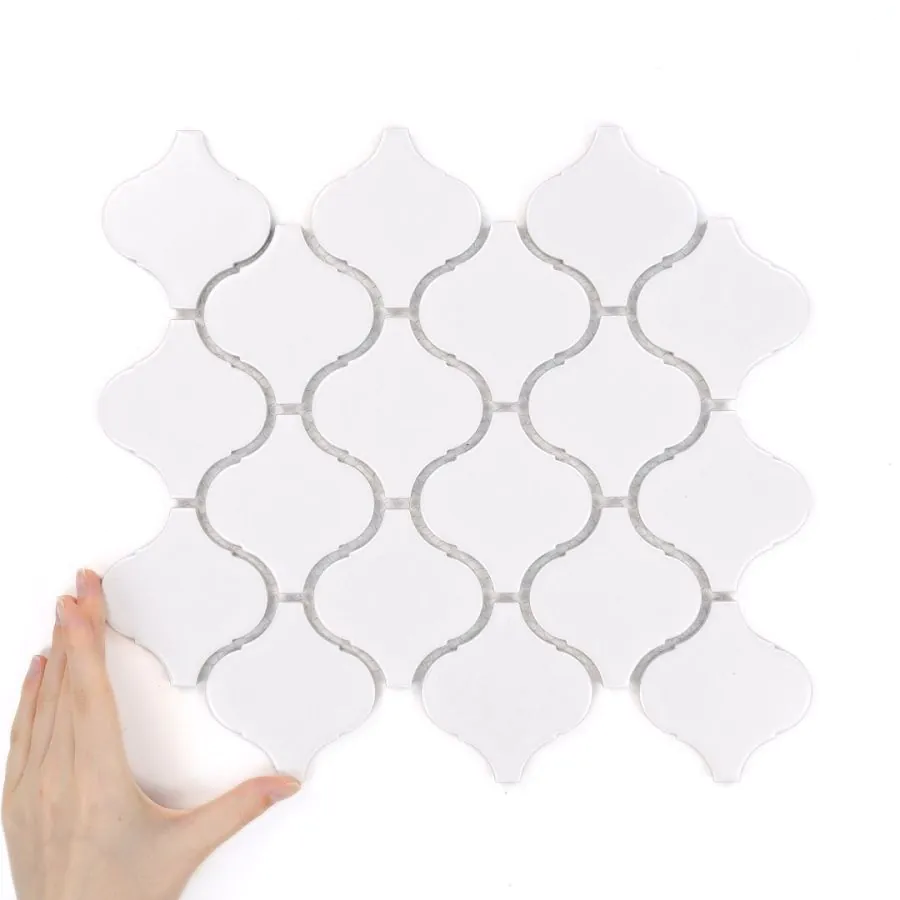
Tile thickness - what does it mean and what should it be? Raw Decor advises
The market offers us a wide range of finishing materials! Among them, however, there are some that have been with us for years. Tiles, of which we speak, are both the first and most obvious choice for the kitchen or bathroom. When starting the search for the right model for you, you should start by establishing one of the key issues - the thickness.


Tile thickness – what you need to know?
It's no secret that choosing tiles is one of the most important decisions we'll face when it comes to interior design. After all, glaze isn't changed very often, quite the opposite - it's a product for years! What should you pay particular attention to and what should guide you when buying?
Well, for the most part, we focus on visual aspects, completely forgetting about technical parameters, and it's precisely these that determine the comfort of use! Tile thickness is one of those issues worth analyzing before visiting the store. So what is it and what exactly is it responsible for?
The thickness of porcelain stoneware is given in millimeters and is statistically from 3 to, attention - 30 mm! It determines resistance to mechanical damage, durability, practicality, application possibilities! Following this line of thought, it's not hard to guess that a few-millimeter glaze won't be the best choice for a floor or terrace!
Tile thickness, is it the same as abrasion resistance?
Terms: tile thickness, porcelain tile thickness and abrasion resistance are sometimes used interchangeably. Especially in colloquial conversations. Is this correct? Yes, because the abrasion class is a parameter that informs about the resistance of tiles to wear and scratches. It provides information on how intensely we can move on the floor. In technical jargon, it is designated as PEI.
- Class I – indicates low abrasion resistance. Tiles of this class will work only in rarely used rooms. They are not scratch-resistant.
- Class II – tiles in this class are suitable for interiors where one walks in soft shoes – exposed to small amounts of dirt.
- Class III – floor tiles for intensively used rooms such as: kitchen or living room. For a corridor or the area near the door, it is better to choose an even higher class.
- Class IV – very good abrasion resistance. Tiles in this class are an excellent choice for the hallway.
- Class V – tiles characterized by the best parameters. Recommended for intensively used rooms. They can be successfully used in public utility areas – shopping malls, airports, hotels.
Raw Decor ceramic tiles are characterized not only by their attractive appearance but also by above-average durability. They have the highest abrasion resistance class, making them suitable for all operating conditions. Another undeniable advantage is the fact that they are very easy and quick to clean. Just a few moments are enough to remove dirt!
Recommended products
Tile thickness – where to look for markings?
Information on tile thickness can be found in the product's technical sheet, where it appears under the acronym PEI. Of course, this is not the only parameter we should pay attention to. In the case of ceramic tiles, aspects such as water absorption, calibration, stain resistance, and anti-slip properties are equally important.
Oh, I almost forgot! Tile rectification, which is the process of finishing the edges of ceramic tiles, involving milling them at a right angle, thanks to which the tiles gain regular edges, almost identical dimensions! They lay much easier, allowing for minimal grout lines! The differences between pieces in one batch do not exceed 0.2 mm.
Porcelain stoneware thickness – expert's statement!
Porcelain stoneware that is to last for years should undoubtedly have the appropriate thickness – experts emphasize. This applies particularly to tiles for heavily used interiors, such as a hallway. Heavy furniture or the clatter of heels could leave marks on low-quality ceramics.
So, how to choose the thickness of floor tiles? First of all, you need to determine the traffic intensity. Think about which rooms are most actively used by household members.
In the toilet, the floor is not used very intensively – thinner tiles can be successfully used. In contrast, in a place like the kitchen, it is worth installing adequately thick tiles – class III-V abrasion resistance is recommended. We spend a lot of time there. We prepare and consume meals, meet for gossip with a friend. As for the bathroom, third-class floor tiles will be sufficient.


Floor tile thickness – do it with Raw Decor!
All kinds of renovation work require proper preparation and knowledge! The help of a tiler can be indispensable! It's worth taking at least one day off, dismantling or properly securing furniture, and additionally buying all necessary equipment.
Trowel in hand, let's get to work? Well, not necessarily! All actions should be preceded by a thorough analysis, specifically an assessment of the condition of the walls and floors that we intend to decorate with tiles. The surface should be smooth, and all kinds of unevenness should be filled! Why is this so important? Skipping this step can result in tiles detaching or cracking, which we certainly wouldn't want!
What's next? After choosing the tiles and preparing the surface, there is still one dilemma - the adhesive. Despite appearances, this is not an easy task. Many products are available on the market.
- White cement-based adhesive – the most universal type of adhesive mortar. Packed in characteristic bags. Requires mixing with a small amount of water.
- Reactive resin-based adhesive – characterized by 100% water resistance and very good adhesion. Recommended for laying ceramic tiles in the kitchen and bathroom.
- Dispersion adhesive – a suspension of insoluble resins that takes on a solid form right after the water evaporates. It is characterized by high resistance to high temperatures and humidity. Odorless!
What should be the thickness of the tile with adhesive? What should be the thickness of the floor tile with adhesive? What should be the thickness of floor tiles with adhesive? Questions that seem to keep both professional tilers and amateurs up at night. Essentially, they are poorly formulated, as they do not take into account many important factors.
- Tile format – in the case of the floor, the relationship is very simple. The larger the tile format, the more adhesive we will need. For a side length of 10 cm, an optimal solution will be a mortar layer of approximately 4-5 mm thickness.
- Absorption of materials – it is recommended to bond tiles using a combined method – apply adhesive both to the tile and to the substrate. This will eliminate the risk of leaving empty spaces.
- Uneven substrate – the thickness of the mortar cannot be increased indefinitely, so proper substrate preparation is absolutely essential!
What should be the thickness of the floor tile with adhesive? A trowel can also be an extremely helpful tool in these calculations. The thickness of the adhesive layer depends on the size of the teeth it has. Below is a practical cheat sheet.
- Side up to 10 cm – 5-6 mm,
- side 10 – 20 cm – 8 mm,
- side 20 – 30 cm – 10 mm,
- side over 30 cm – 12 mm.
During installation, it is important to gently press the tiles into the applied mortar, while lightly rotating them. You should also remember to leave a grout line of at least 2 mm. The method of laying the tiles is also important! Diamond, herringbone, brick, mosaic – as many tiles, as many possibilities! If we are not entirely decided on which method to choose, a good idea is to unpack several boxes and lay out the tiles in various "dry" variants – i.e., without adhesive.
How to clean and care for tiles immediately after installation?
After laying the floor tiles, we must wait a minimum of one day to apply the grout. The mortar under the tiles must be one hundred percent dry, and the tiles themselves must be free of spacers and thoroughly cleaned.
How to get rid of excess adhesive after installation? A very good way to remove it is to use a plastic straw. Simply run it a few times over the joint – so that the excess adhesive gets onto its surface. The next step will be to apply an agent with a slightly acidic pH. The tiles moistened with it, after waiting the time indicated by the manufacturer, should be rinsed with clean water.
Raw Decor Tiler's Tip!
Too thick a layer of adhesive mortar can cause the mosaic to sink. Adhering to the instructions on the mortar packaging and proper substrate preparation are crucial here!
Tile thickness — what does it matter and what should it be? Summary
Tile thickness is not just some number, but above all durability and resistance to damage! Loads! Better acoustics and user comfort! When it comes to the floor, 5-9 millimeter tiles will be the optimal choice. It is important that they are in abrasion resistance class III-V.
For the whole to look attractive, the right adhesive must be chosen, which, like tile thickness, is greatly underestimated in interior finishing, as it is ultimately not visible. In home interiors, mortar based on white cement will work very well. What should be the thickness of floor tiles with adhesive? It is difficult to give a clear answer, after all, the choice of ceramics is huge! Each model has its own rules, has individual specifications!
However, when it comes to the process of laying ceramic tiles, proper preparation of the substrate will be crucial here! Raw Decor mosaic is very demanding in this regard! Even slight deviations are unacceptable! However, the final effect will certainly reward all the effort! For more details, we invite you to our Youtube channel, where we show all the necessary steps step by step! From preliminary work to finishing!